Science &
Wellness
The Somnara ecosystem is built on decades of sleep science, air quality research, and aromatherapy evidence.
Clean air improves
sleep quality.
Elevated PM2.5, VOC, and CO2 levels in bedroom air disrupt sleep architecture — increasing nighttime awakenings, reducing slow-wave sleep, and impairing cognitive recovery.
PM2.5 Reduction
Reduced PM2.5 exposure associated with 15–20% improvement in sleep efficiency in urban dwellers.
CO₂ & Bedroom Air Quality
Published indoor-air research examines overnight ventilation, carbon-dioxide levels, and subjective sleep-related outcomes. It does not establish a Somnara Aura™ benefit.
Allergen & Sleep Quality
HEPA filtration in bedrooms reduces allergen-related nighttime awakenings by 30–40% in sensitized individuals.
VOC Exposure
Volatile organic compounds from furnishings and cleaning products disrupt REM sleep and reduce slow-wave sleep duration.
Scent and sleep
architecture.
Published aromatherapy research has examined associations among scent, relaxation, mood, and sleep-related outcomes. Those findings are ingredient-level context and do not establish a product-specific outcome for Somnara Aura™ or Nocelle™.
Nocelle™ is being designed to diffuse scent through the Aura’s conditioned airstream. Adaptive intensity based on EchoLoom™ wellness estimates remains an engineering target pending validation.
Lavender
Commonly studied in aromatherapy research. Nocelle™-specific wellness outcomes have not been established.
Bergamot
Commonly used in relaxation-oriented aromatherapy. Product-specific outcomes remain unvalidated.
Cedarwood
An aromatic profile under consideration for the Nocelle™ library; no treatment or sleep-outcome claim is made.
Chamomile
A familiar botanical scent profile presented for user preference, not diagnosis, treatment, or guaranteed sleep benefit.
Adaptive Scent Design Target
Nocelle™ is being designed to adjust intensity using EchoLoom™ wellness estimates and user preferences. Final behavior and performance remain pending validation.
How Cozy EchoLoom™ Radar is being
developed.
EchoLoom™ is being developed to provide contact-free wellness-oriented sleep-state estimates and breathing features; it is not a diagnostic device.
Contact-Free Design
Designed to derive movement and breathing-pattern features without a wearable, camera, or microphone.
Wellness Estimates
Designed to present estimated nighttime patterns for informational wellness use, not clinical interpretation.
Independent Validation Planned
Product-specific sleep-state and breathing-feature performance has not yet been independently validated against polysomnography.
Sleep is when your brain cleans itself.
The glymphatic system — the brain's waste-clearance network — is almost exclusively active during deep slow-wave sleep. Disrupted sleep is now linked to accelerated accumulation of amyloid-beta and tau proteins, the hallmarks of Alzheimer's disease.
The PM2.5 and Alzheimer's Connection
Emerging epidemiological research has identified a significant association between long-term PM2.5 exposure and increased risk of Alzheimer's disease and related dementias. Fine particulate matter crosses the blood-brain barrier and triggers neuroinflammation — the same inflammatory cascade implicated in neurodegeneration.
The bedroom is where humans spend the most consecutive hours breathing — 7 to 9 hours per night, for decades. Reducing PM2.5 across the sleep zone during sleep is one of the highest-leverage interventions available for long-term brain health.
"Long-term PM2.5 exposure associated with 16% increased risk of dementia per 10 micrograms per cubic meter increment." — The Lancet Planetary Health, 2023
The Glymphatic System and Deep Sleep
During N3 slow-wave sleep, the brain's interstitial space expands by up to 60%, allowing cerebrospinal fluid to flush metabolic waste — including amyloid-beta — at rates 10 to 20 times higher than during wakefulness. Even a single night of poor sleep measurably increases amyloid-beta levels in the brain.
The Somnara Aura™ is designed specifically to maximize the conditions for deep slow-wave sleep: clean air across the sleep zone, environmental noise masking, stage-adaptive audio, and a gradual wake protocol that avoids abrupt arousal from N3.
"Glymphatic clearance during sleep is critical for removing neurotoxic waste. Sleep deprivation significantly impairs this process." — Science, Xie et al., 2013
Advancing the science of sleep medicine.
Cozy Sleep Systems has submitted a proposal to the Advanced Research Projects Agency for Health (ARPA-H) under the Resilient and Equitable Sleep Technologies (REST) program. The proposal outlines a 13-institution research consortium using the Somnara Aura™ as the platform for a large-scale, real-world study of sleep intervention efficacy.
If funded, this would represent one of the largest naturalistic sleep studies ever conducted — generating data that could reshape clinical guidelines for sleep medicine, air quality standards, and brain health interventions.
1% of every sale funds sleep research.
Cozy Sleep Systems pledges 1% of all revenue to the Alzheimer’s Drug Discovery Foundation (ADDF) — the world’s leading venture philanthropy funding breakthrough Alzheimer’s treatments and prevention research. This commitment is unconditional and applies from the first unit sold.
We believe the companies building the tools people use every night have a responsibility to advance the science behind them. The ADDF has funded over 700 research programs across 20 countries, accelerating the path from laboratory discovery to clinical treatment. Our 1% Pledge is our commitment to that mission.
The right sound
deepens sleep.
Acoustic masking reduces cortical arousal responses to environmental noise — the micro-awakenings that fragment sleep without you ever fully waking. The right noise colour does this more effectively than silence.
Pink Noise & Slow-Wave Sleep
A 2017 study in Frontiers in Human Neuroscience found that pink noise synchronized to slow oscillations increased slow-wave sleep by 23% and improved declarative memory consolidation the following morning. Pink noise's equal energy per octave closely matches the spectral profile of natural environments — rain, wind, and rustling leaves — which may explain its particular effectiveness.
Brown Noise & Cognitive Calm
Brown noise (also called red noise) has a steeper low-frequency emphasis than pink noise, producing a deeper, warmer sound. Many users report reduced mental chatter and faster sleep onset with brown noise compared to white noise, particularly those sensitive to higher-frequency sounds. It is the preferred choice for tinnitus masking.
Acoustic Masking of Arousals
Published research has examined environmental noise and the use of broadband masking sounds. Individual responses vary, and Cozy does not claim that Airstream Audio™ changes sleep duration, sleep architecture, or a medical outcome.
Lullabies & Children's Sleep Onset
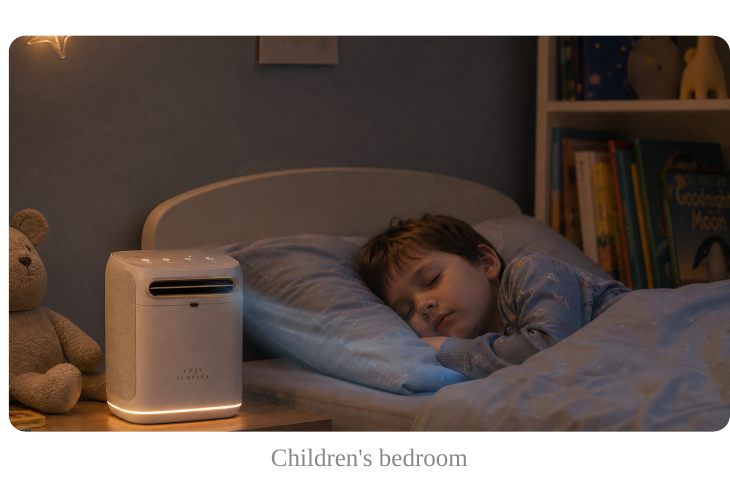
Rhythmically regular, low-tempo music (60–80 BPM) is associated with faster sleep onset in infants and toddlers. Lullabies in this range synchronize with the natural resting heart rate, promoting parasympathetic dominance and reducing pre-sleep arousal. The Cozy library includes original lullabies and classic melodies in this range, fading automatically when the Aura detects sleep onset.
DawnLoom™ by Cozy
Light is the most powerful circadian signal.
Published light research informs the DawnLoom™ blue-spectrum concept. The current design target is near 480 nm, but final spectral output, safety testing, and product-specific effects have not yet been independently validated.
Circadian Light Sensitivity
Published research identifies 480 nm as the peak sensitivity wavelength for melanopsin in ipRGC cells. These findings inform the DawnLoom™ design but do not constitute product-specific efficacy claims for the Somnara Aura™.
Gradual-Wake Research
Published studies have examined gradual light-based wake protocols. Those findings provide general design context and do not establish a DawnLoom™ outcome or performance percentage.
Circadian Entrainment Research
Published research associates consistent morning light exposure with circadian rhythm stabilization. These general findings inform the DawnLoom™ design approach. Product-specific outcomes have not yet been independently validated.
DawnLoom™ Development Status
DawnLoom™ is being designed as an adjustable blue-spectrum light that gradually brightens near a scheduled wake time. Final wavelength, intensity, ramp duration, and photobiological-safety specifications remain subject to engineering verification.
The intended experience is a gentler visual transition than an abrupt alarm. Cozy does not claim that DawnLoom™ changes cortisol, suppresses melatonin, improves cognition, or guarantees alertness or any other physiological outcome.
Science you can sleep on.
The Somnara ecosystem applies decades of sleep research to your bedroom — automatically, every night.